Sailor Moon (Season 1) – Anime Review (Revamped)

📺 TL;DR
Sailor Moon Season 1 is a magical-girl classic filled with friendship, courage, romance, humor, and—of course—a whole lot of magic. Although its monster-of-the-week battles are frequent, most of the violence is fantastical rather than graphic, with very little blood or gore. There are some potentially frightening monsters, brief nonsexual nudity/silhouettes, mild language, romantic themes, reincarnation, and a few elements families may want to discuss depending on their beliefs and their child’s maturity.
⭐ At a Glance
The Anime Momma Age Recommendation: 👧 Young Children | Approx. 5–7+
Appropriate for most young viewers with minimal concerns.
Official Age Rating: Ratings vary by release and region. The series has received ratings ranging from children’s/family classifications to TV-PG/TV-14 depending on the version and distribution.
The Anime Momma Rating: ⭐⭐️⭐️⭐️☆ 4.5/5
Intended Demographic: Shoujo
Genres: Magical Girl • Fantasy • Romance • Comedy • Action
Episodes: 46 episodes in the original Japanese first season
- Version Note: The original Japanese Season 1 contains 46 episodes. The older DiC English adaptation condensed the season to 40 episodes and made numerous edits to dialogue, relationships, violence, and other content. Because of those differences, some of the details in this review may vary depending on the version your family watches.
📖 Story Summary
Usagi Tsukino is not exactly who you would expect to save the world. She’s fourteen years old, struggles in school, loves food and video games, cries easily, and would generally prefer not to be fighting terrifying monsters after class… Then she meets a mysterious talking cat named Luna.
Luna reveals that Usagi has a hidden identity: Sailor Moon, a Guardian destined to fight against the forces of darkness threatening Earth.
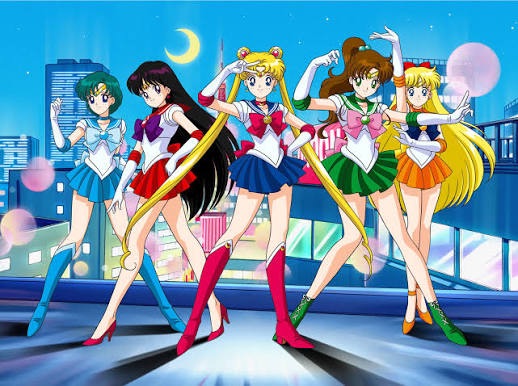
Armed with a magical transformation brooch—and initially very little idea what she’s doing—Usagi begins battling monsters sent by the Dark Kingdom to steal human energy. Along the way, she discovers that she isn’t alone. Other Sailor Guardians gradually join her, each bringing her own personality, abilities, strengths, and weaknesses to the team.
But their mission becomes much bigger than defeating the monster of the week.
The Guardians must locate the mysterious Moon Princess, protect the Legendary Silver Crystal, uncover the truth about the ancient Moon Kingdom, and confront a past that connects them more deeply than any of them realize.
At its heart, Sailor Moon is a story about an ordinary, imperfect girl learning that courage doesn’t require her to stop being afraid—and that love, friendship, loyalty, and compassion can become strengths of their own.

⭐ Star Levels
⭐ = very little present | ⭐⭐⭐⭐⭐ = heavily present
⚔️ Action — ⭐⭐⭐⭐☆ (4/5)
🩸 Blood & Gore — ⭐☆☆☆☆ (1/5)
🌀 Mature Themes — ⭐⭐☆☆☆ (2/5)
✨ Magic/Fantasy — ⭐⭐⭐⭐⭐ (5/5)
💕 Romance — ⭐⭐⭐⭐☆ (4/5)
🌈 Alternative Lifestyles — ⭐⭐☆☆☆ (2/5)
👶 Family-Friendly — ⭐⭐⭐⭐☆ (4/5)
⭐ Breaking Down the Ratings
⚔️ Action — ⭐⭐⭐⭐☆ (4/5)
There is a fight in some form during most episodes.
The Sailor Guardians battle supernatural monsters using magical attacks, elemental abilities, magical objects, and occasional physical combat. Characters may be grabbed, thrown, restrained, knocked unconscious, shocked, injured, or otherwise placed in danger.
Sailor Moon’s tiara becomes a weapon, while the other Guardians develop their own signature attacks involving fire, water, lightning, and other supernatural abilities.
Despite how frequent the action is, it isn’t particularly graphic. This anime is colorful magical-girl battles at its finest.
The biggest jump in intensity occurs toward the end of the season. The final episodes involve significantly greater danger, injury, sacrifice, and character deaths than the typical monster-of-the-week episodes.
So while I give the amount of action a 4/5, that doesn’t mean I’m giving the graphicness of that action a 4/5. I’d say the graphicness is actually about a 2/5.
Those are very different things.
🩸 Blood & Gore — ⭐☆☆☆☆ (1/5)
Very little.
Characters may receive cuts, scrapes, bruises, or other visible injuries during battles, particularly during the more serious parts of the season.
There is also an instance involving a character losing a significant amount of green-colored blood/ooze, but it is clearly fantasy-like and not actually realistic human gore.
Some monsters disintegrate or otherwise disappear when defeated.
Overall, Sailor Moon contains plenty of fighting without relying on graphic injury.
🌀 Mature Themes — ⭐⭐☆☆☆ (2/5)
For most of the season, mature material remains fairly mild.
There may be occasional mild profanity or name-calling depending on the dub/subtitle track you’re watching.
There are also some brief moments of suggestive humor or imagery. Female characters wear revealing outfits, and the Sailor Guardians’ transformation sequences show their bodies as glowing, featureless nude silhouettes before their uniforms appear. These scenes aren’t framed sexually, but parents who avoid any depiction of nudity should know they’re present.
The story eventually explores heavier concepts including death, sacrifice, destruction, loss, evil, and the fall of an ancient civilization.
The Dark Kingdom also steals people’s energy throughout the series. Victims often collapse or behave strangely afterward, although this is handled as fantasy rather than realistic physical abuse.
The final episodes are considerably more emotionally intense than the majority of Season 1.
✨ Magic/Fantasy — ⭐⭐⭐⭐⭐ (5/5)
Oh yes. Allllll the magic. 😂🌙✨
This is Sailor Moon, after all.
Magical transformation brooches, enchanted crystals, supernatural attacks, talking cats, monsters, energy manipulation, reincarnation, past lives, planetary Guardians, an ancient Moon Kingdom, prophecy-like destiny, magical healing and more are woven throughout the story.
The villains also use supernatural powers and seek human energy for their own purposes.
Some episodes incorporate things such as fortune-telling or other supernatural imagery.
Magic isn’t simply decoration here—it’s foundational to the entire world and story.
Families who distinguish between fictional fantasy magic and real-world occult practices may find Sailor Moon easy enough to contextualize, while families who prefer to avoid magical or reincarnation-based stories altogether will probably want to skip this one.

💕 Romance — ⭐⭐⭐⭐☆ (4/5)
Romance is an important part of Sailor Moon, although Season 1’s romantic content itself remains fairly innocent.
Expect crushes, blushing, flirting, jealousy, longing, hugs, romantic declarations, and some kissing.
Usagi is also extremely interested in romance and attractive boys.
The central relationship between Usagi (Serena) and Mamoru (Darien)/Tuxedo Mask becomes increasingly important as the season progresses, particularly once the characters begin discovering their connection to the ancient Moon Kingdom.
Their romance is tied heavily to the show’s reincarnation/past-life storyline.
One thing worth mentioning is that the anime presents Mamoru as noticeably older than Usagi, who is fourteen. The relationship is portrayed romantically rather than critically, so this can be a worthwhile conversation with older children about the difference between fictional romance and healthy real-world dating boundaries.
🌈 Alternative Lifestyles — ⭐⭐☆☆☆ (2/5)
There is some same-sex romantic representation in Season 1, primarily among the villains.
Zoisite and Kunzite are presented as having a romantic relationship in the original Japanese version. Their affection is apparent through their interactions, but the relationship isn’t sexually explicit.
This is also an excellent example of why which version of Sailor Moon you’re watching matters.
The older English DiC adaptation changed Zoisite into a woman, effectively turning the relationship into a heterosexual one. More faithful modern releases preserve the characters and relationship as originally written.

There are also occasional moments in which female characters comment on another girl’s beauty or attractiveness, although those comments aren’t necessarily romantic.
Families wanting to evaluate LGBTQ+ representation before viewing should make sure they know which release they’re watching.
👶 Family-Friendly — ⭐⭐⭐⭐☆ (4/5)
Overall, I consider Season 1 quite family-friendly.
There is no graphic sexual content, gore is extremely limited, most violence is fantastical, and the series repeatedly celebrates friendship, courage, loyalty, compassion, perseverance, and protecting others.
The Sailor Guardians don’t begin as perfect superheroes, either.
They’re girls with fears, insecurities, arguments, crushes, school problems, different personalities, and very real weaknesses. Yet they continually learn to work together and put themselves in harm’s way for other people.
That’s one of the things I’ve always loved about this series.
I take one star away primarily because of the frightening imagery, brief suggestive/nude-silhouette content, heavier season finale, and several themes that some families may want to discuss rather than watch without context.
⚠️ Parent Awareness Notes
🌙 The Finale Gets Much Heavier
Don’t let the silliness of the early episodes completely fool you.
Season 1 eventually deals with death, grief, sacrifice, and significant danger to beloved characters. The last few episodes are much more emotionally intense than most of the season.
A child who happily handles the weekly monsters may still find the finale upsetting.
🌙 Past Lives & Reincarnation
Reincarnation isn’t merely mentioned in passing. The characters’ past lives and identities during the ancient Moon Kingdom are important to the plot.
For families whose religious beliefs conflict with reincarnation, this may be worth discussing as part of the show’s fictional mythology rather than simply allowing younger children to assume it reflects your family’s beliefs.
🌙 Usagi & Mamoru’s Age Difference
Usagi is fourteen, while Mamoru is portrayed as older (about eighteen) in this anime adaptation. Their relationship is framed as a destined romance extending across their past and present lives.
I don’t think this means families need to avoid the series, but I also don’t think we have to pretend fictional romance automatically models a healthy real-world relationship.
This can actually become a useful conversation:
Something being romantic in a story doesn’t necessarily make the same situation wise or appropriate in real life.

🌙 Your Version Matters
The original Japanese anime, modern uncut releases, and older English-language adaptations are not identical.
Older English versions edited violence, dialogue, relationships, religious/cultural references, and other material. Modern releases are generally much more faithful to the Japanese original.
If something you’ve read about Sailor Moon doesn’t seem to match what you’re watching, this may be why!
💭 My Thoughts
Sailor Moon holds a really special place in my heart because I was one of those little kids watching it.
And I loved it.
The transformations. The princesses. The romance. The ridiculously dramatic villains. The friendships. The attacks we all absolutely tried to imitate when nobody was looking…
What? I know I wasn’t the only one!
There’s a reason this series became such an enormous part of anime history.
But watching something as a child and evaluating it later through The Anime Momma lens are two very different experiences.
Looking at it now, I can see plenty of things that younger me never thought twice about: reincarnation, age differences, scary monsters, revealing character designs, some relationship content, and a finale that is a lot darker than you might expect from the adorable girl with the meatball buns for hair.
But I can also appreciate the heart of Sailor Moon even more.
Usagi isn’t brave because she’s fearless.
She’s brave while being scared.
She’s emotional. She’s immature. She messes up. She cries… A lot. (Cough, relatable, cough.)
And yet when the people she loves need her, she keeps getting back up.
Her softness isn’t something she has to lose before she can become strong.
I think that’s beautiful.
🌸 The Anime Momma Verdict
Sailor Moon Season 1 remains one of anime’s quintessential magical-girl stories for a reason. Beneath the sparkles, transformations, comedy, monsters, and romance is a story about ordinary girls learning courage, choosing friendship, protecting one another, and discovering that compassion can coexist with strength. Its frequent fantasy battles, occasional frightening imagery, reincarnation themes, brief nonsexual nudity, relationship elements, and surprisingly emotional finale mean parents of very young or sensitive children may want to watch alongside them—but for many families, I think this can be a wonderful first anime.

Applicable Verdict Pins
🌸 Anime Momma Favorite
⚠️ Parent Awareness
🍀 Great Starter Anime
🧑🧑🧒 Family Friendly

Applicable Database Icons
🌸 Anime Momma Favorite
✅ Watched
⚔️ Action
💕 Romance
✨ Magic/Fantasy
👶 Family-Friendly
💡 Anime Momma Corner
Parent Conversation
One of my favorite things about Usagi is that she challenges the idea that courage means not being afraid.
She cries.
She wants to run away.
Sometimes she complains about having to fight at all.
And then she does it anyway.
That’s a fantastic opportunity to ask younger viewers:
“Do you think someone can be brave and scared at the same time?”
You could even talk about moments when your child has done something difficult despite feeling nervous or afraid.
Because courage isn’t the absence of fear.
Sometimes courage looks like trembling, crying, wishing you didn’t have to do the hard thing…
and choosing to do what’s right anyway.
🌸 Final Thoughts
Sailor Moon isn’t perfect, and I don’t think loving something from our childhood means we have to pretend it is.
Honestly, I think revisiting childhood favorites with discernment can make appreciating them even more meaningful.
I can acknowledge the parts I’d want parents to know about while still saying:
I love Sailor Moon. 🌙💕
It gave generations of girls heroes who could be feminine, emotional, funny, romantic, imperfect, compassionate and powerful.
And decades later, Usagi and the Sailor Guardians are still reminding new viewers that you don’t have to become someone completely different before you can make a difference.
Sometimes growing into the person you’re meant to be begins with discovering that there was already something worth believing in inside you.
Until next time,
Tam 🌸
The Anime Momma

At The Anime Momma Blog, my goal is simple: to help parents, guardians, and anime lovers alike understand anime so they can watch with wisdom and discernment and have meaningful conversations along the way.
A guide for those who want to enjoy anime thoughtfully, understand it deeply, and engage with it without losing sight of real life, healthy relationships, and personal growth.
🔗 Social Links
Come hang out with The Anime Momma on social media for more anime reviews, age recommendations, parent resources, anime discussions, and all-around anime fun! 🌸✨
Leave a Reply